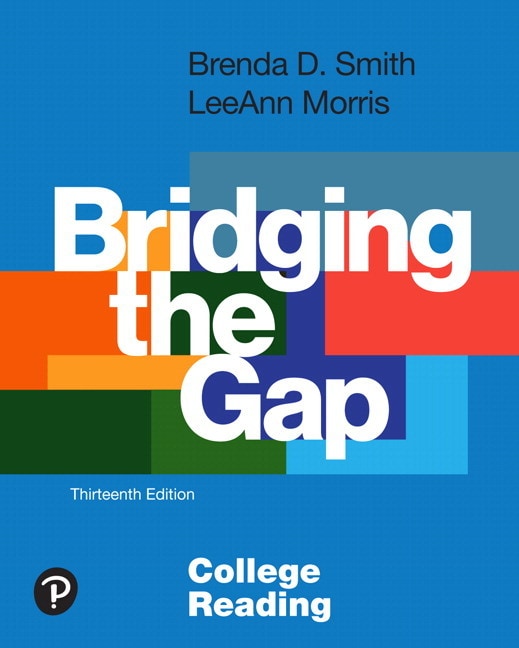
Bridging the Gap: College Reading, 13th edition
$24.00
📚 Delivered within 24 hours via email Bridging the Gap: College Reading is your comprehensive guide to reading, understanding and retaining college-level material. The text is designed to help you build upon prior knowledge with its trusted scaffolded approach and its unmatched quality and quantity of practice exercises. As the higher-level text in the acclaimed Smith/Morris 2-book series, it provides ample opportunities to apply your skills, ultimately helping you build new “bridges” of text-to-text, text-to-world and text-to-self connections
The 13th Edition upholds the philosophy and approach of previous editions in an updated and contemporary manner. Each chapter is a steppingstone to the next, and readings throughout include engaging, relevant topics pertinent to the college community. Examples from respected sources, such as The Associated Press and the Los Angeles Times, model strong writing. Lexile levels have also been added next to longer readings.
Published by Pearson (June 11th 2021) – Copyright © 2022
ISBN-13: 9780137563012
Subject: Developmental English
Category: Developmental Reading
Description
Table of Contents
- ACTIVE ACADEMIC READING
- What Is Active Academic Reading?
- What Can We Learn From Cognitive Psychology and Neuroscience?
- Brain Booster: Are You Paying Attention?
- Help Your Brain Absorb New Information
- Poor Concentration: Causes and Cures
- External Distractions
- Internal Distractions
- Brain Booster: Are You Curious?
- Reader’s Tip: Improving Concentration
- Reader’s Tip: Managing Electronic Communication
- Is Reading Rate Important?
- Varying Rate and Technique to Fit Purpose
- Rate Variations and Prior Knowledge
- Reader’s Tip: Efficient Reading: Adjusting Rate and Technique to Material and Purpose
- What Is Your Baseline Reading Rate?
- Brain Booster: Music to Our Ears and to Our Brains
- Habits for Faster Reading
- Plan for Success on Reading Comprehension Tests
- Before Taking a Test
- Brain Booster: Balance Memorization and Application in Test Preparation
- During the Test
- After the Test
- Brain Booster: Turn Mistakes into Successes
- Major Types of Comprehension Questions
- Main Idea Questions
- Detail Questions
- Inference Questions
- Author’s Purpose Questions
- Vocabulary Questions
- Essay Questions
- Reader’s Tip: Key Words in Essay Questions
- Locus of Control
- SUMMARY POINTS
- SELECTION 1 Psychology
- “Are you Stalling? Win the Battle Against Procrastination!”
- from Samuel E. Wood, Ellen Green Wood, and Denise G. Boyd
- CONCEPT PREP FOR PSYCHOLOGY
- SELECTION 2 History
- “Home Front Workers, Rosie the Riveter, and Victory Girls”
- from Jacqueline Jones, et al.
- CONCEPT PREP FOR HISTORY
- SELECTION 3 Science
- “Is there Enough Earth for Everyone?”
- from Teresa Audesirk, Gerald Audesirk, and Bruce E. Byers
- CONCEPT PREP FOR SCIENCE
- VOCABULARY BOOSTER: Over, Under, Around, and Through
- STRATEGIC READING AND STUDY
- What Is Strategic Reading?
- Four Types of Readers
- The Stages of Reading
- Stage 1: Strategies for Previewing
- Signposts for Previewing
- Reader’s Tip: Ask Questions While Previewing
- Preview to Activate Schemata
- Brain Booster: Schemata and Your Brain
- Stage 2: Strategies for Integrating Knowledge While Reading
- Integrating Ideas: How Do Good Readers Think?
- Metacognition
- Reader’s Tip: Using Thinking Strategies While Reading
- Reader’s Tip: Developing Metacognition for Reading
- Stage 3: Strategies for Recalling
- Recalling Through Writing
- The Three Steps of Recalling
- Reader’s Tip: Thinking After Reading
- Brain Booster: Use It to Remember It!
- SUMMARY POINTS
- SELECTION 1 History
- “Madam C. J. Walker: Business Savvy to Generous Philanthropy”
- from America.gov Archive
- SELECTION 2 Health
- “High-Risk Drinking and College Students”
- from Rebecca J. Donatelle and Patricia Ketchum
- SELECTION 3 Business
- “The Entrepreneurial Spirit”
- from Robert S. Feldman
- CONCEPT PREP FOR BUSINESS
- VOCABULARY BOOSTER: The Good, the Bad, and the Ugly
- ORGANIZING TEXTBOOK INFORMATION FOR STUDY
- Get Organized for College Study
- Building Knowledge Networks
- The Study Process
- Organizing Textbook Information
- Brain Booster: Exercise to Boost Brain Power
- Annotating
- Why Annotate?
- Reader’s Tip: How to Annotate
- When to Annotate
- Note Taking
- When and How to Take Notes
- The Cornell Method
- Reader’s Tip: How to Take Notes: The Cornell Method
- Outlining
- Reader’s Tip: Guidelines for Successful Outlining
- Brain Booster: Sleep and Problem Solving
- Mapping
- Reader’s Tip: How to Map
- SUMMARY POINTS
- SELECTION 1 Business Communications
- “Marketing ‘Tasty Fun’ and ‘Dashing Speed’”
- from Gary Armstrong and Philip Kotler
- CONCEPT PREP FOR COMMUNICATIONS AND LANGUAGE
- SELECTION 2 Health
- “Managing Stress in College”
- from Rebecca J. Donatelle
- CONCEPT PREP FOR HEALTH
- SELECTION 3 Criminal Justice
- “Police DNA Collection Sparks Questions”
- from the Associated Press
- CONCEPT PREP FOR CRIMINAL JUSTICE
- VOCABULARY BOOSTER: Who’s Who in Medicine?
- VOCABULARY
- Remembering New Words and Unlocking Meaning
- Associate Words in Phrases
- Associate Words with Rhymes or Sounds
- Brain Booster: Use Your Senses to Make More Sense!
- Associate Words With Images
- Seek Reinforcement
- Create Concept Cards
- Use Strategies to Unlock Meaning While Reading
- Using Context Clues
- Definition or Synonym Clues
- Elaborating Details Clues
- Examples
- Comparison Clues
- Contrast Clues
- Antonyms
- Limitations of Context Clues
- Multiple Meanings of a Word
- Understanding the Structure of Words
- Using Word Reference Aids
- Using a Dictionary
- Using a Glossary
- Using a Thesaurus
- Brain Booster: Meaning Matters!
- Deepening Word Meaning
- Exploring Word Origins
- Solving Analogies
- Reader’s Tip: Categories of Analogy Relationships
- Studying Easily Confused Words
- SUMMARY POINTS
- SELECTION 1 Health
- “Mobile Devices, the Internet, and iDisorders”
- from Rebecca J. Donatelle
- VOCABULARY BOOSTER: What’s In, What’s Out? What’s Hot, What’s Not?
- MAIN IDEA AND SUPPORTING DETAILS
- Topics, Main Ideas, and Supporting Details
- What Is a Topic?
- What Is a Main Idea?
- What Are Supporting Details?
- Distinguishing Topics, Main Ideas, and Details: A Closer Look
- Strategies for Finding the Main Idea
- Prior Knowledge and Constructing the Main Idea
- Identifying Main Ideas Among Sentences
- Reader’s Tip: Using Three Questions to Find the Main Idea
- Questioning for the Main Idea
- Stated Main Ideas
- The Topic Sentence
- How Common Are Stated Main Ideas?
- Where Are Stated Main Ideas Located?
- What Are Major and Minor Details?
- Reader’s Tip: Signals for Significance
- Unstated Main Ideas
- Unstated Main Ideas in Sentences
- Unstated Main Ideas in Paragraphs
- Determining the Main Idea of Longer Selections
- Reader’s Tip: Getting the Main Idea of Longer Selections
- Brain Booster: Brains Need the Right Amount of Sleep
- Summary Writing: A Main Idea Skill
- Why Summarize?
- Reader’s Tip: How to Summarize
- Brain Booster: Chronic Stress and the Brain
- SUMMARY POINTS
- SELECTION 1 Psychology
- “The Obedience Study”
- from Carole Wade, Carol Tavris, and Maryanne Garry
- CONCEPT PREP FOR PSYCHOLOGY
- SELECTION 2 Short Story
- “Life with Cooper”
- from Julia Jones
- CONCEPT PREP FOR LITERATURE
- SELECTION 3 Criminal Justice
- “Fighting Violent Gang Crime with Math”
- from Stuart Wolpert
- VOCABULARY BOOSTER: The Sun, the Moon, and the Stars
- PATTERNS OF ORGANIZATION
- Textbook Organization: The Big Picture
- What Do Transitional Words Do?
- Words That Signal Addition
- Words That Signal Examples or Illustrations
- Words That Signal Time or Sequence
- Words That Signal Comparison
- Words That Signal Contrast
- Reader’s Tip: Transitions and Their Functions
- Words That Signal Cause and Effect
- Patterns of Organization in Textbooks
- Brain Booster: Brains Like Patterns
- Simple Listing
- Definition
- Description
- Time Order, Sequence, or Narration
- Comparison
- Contrast
- Comparison and Contrast
- Cause and Effect
- Classification
- Summary
- Location or Spatial Order
- Generalization and Example
- Reader’s Tip: Patterns of Organization and Signal Words
- Clues to the Organizational Pattern
- Brain Booster: Watering the Brain
- Mixed Organizational Patterns
- SUMMARY POINTS
- SELECTION 1 Communications
- “Managing Conflict”
- from Joseph A. DeVito
- SELECTION 2 History
- “North Americans Before Columbus”
- from David Goldfield, et al.
- Concept Prep for Art History
- SELECTION 3 Business
- “The Dark Side of Consumer Behavior”
- from Michael R. Solomon
- VOCABULARY BOOSTER: Can I Get That in Writing?
- INFERENCE
- What Is an Inference?
- What Is Required to Make a Reasonable Inference?
- Implied Meaning in Humor
- Brain Booster: The Brain’s Pleasure Center and Learning
- Connotative Language
- Euphemisms and Politically Correct Language
- Figurative Language
- Idioms
- Similes
- Metaphors
- Hyperbole
- Personification
- Verbal Irony
- Figurative Language in Poetry
- Clues to Making Logical Inferences
- Inferences Based on Facts
- Inferences Based on the Voice of a Speaker or Narrator
- Inferences Based on Action and Description
- Inferences Based on Prior Knowledge
- Brain Booster: Boost Brain Power Through Collaboration
- Expanding Prior Knowledge
- Reader’s Tip: Making Inferences
- Drawing Conclusions
- SUMMARY POINTS
- SELECTION 1 Short Story
- “A Dip in the Poole”
- from Bill Pronzini
- CONCEPT PREP FOR PHILOSOPHY AND LITERATURE
- SELECTION 2 Philosophy/Religion
- “Religion Today”
- from Mary Pat Fisher and Robin Rinehart
- SELECTION 3 Personal Narrative
- “Fear the College Years”
- from John Corcoran
- CONCEPT PREP FOR POLITICAL SCIENCE
- VOCABULARY BOOSTER: Say, What?
- POINT OF VIEW
- What Is the Author’s Point of View?
- Textbooks and the Author’s Point of View
- What Is Bias?
- Reader’s Tip: Questions to Uncover Bias
- The Importance of the Reader’s Point of View
- Brain Booster: Male and Female Brains and Their Points of View
- What Are Facts and Opinions?
- What Is the Author’s Purpose?
- What Is the Author’s Tone?
- Reader’s Tip: Recognizing an Author’s Tone
- Using Tone and Other Clues to Determine the Point of View in Editorial Cartoons
- SUMMARY POINTS
- SELECTION 1 Philosophy
- “Decision”
- from Gary R. Kirby and Jeffery R. Goodpaster
- SELECTION 2 Science
- “Earth’s Changing Climate”
- from Teresa Audesirk and Gerald Audesirk
- SELECTION 3 Psychology
- “Mental Disorder and Personal Responsibility”
- from Carole Wade and Carol Tavris
- VOCABULARY BOOSTER: Lights, Camera, Action!
- GRAPHIC ILLUSTRATIONS
- What Graphics Do
- Reader’s Tip: How to Read Graphic Illustrations
- Types of Graphic Illustrations
- Diagrams
- Tables
- Maps
- Pie Graphs
- Bar Graphs
- Cumulative Bar Graphs
- Line Graphs
- Flowcharts
- SUMMARY POINTS
- SELECTION 1 Personal Narrative
- “Little Income, Big Debt: Managing Money in College”
- from Trent Hamm
- SELECTION 2 Health
- “Get Fit!”
- from J.Scott K. Powers and Stephen L. Dodd
- SELECTION 3 Teacher Education
- “Freedom of Speech, Technology, and Teaching”
- from Don Kauchak and Paul Eggen
- VOCABULARY BOOSTER: Play It Again, Sam
- CRITICAL THINKING
- What Is Thinking?
- What Is Analytical Thinking?
- What Is Critical Thinking?
- Reader’s Tip: Four Habits of Effective Critical Thinkers
- Critical Thinking Skills and College Goals
- Barriers to Critical Thinking
- Recognizing an Argument
- Steps in Analyzing and Evaluating an Argument
- Step 1: Identify the Position on the Issue
- Step 2: Identify the Support in the Argument
- Reader’s Tip: Types of Support for Arguments
- Step 3: Evaluate the Support
- Step 4: Evaluate the Argument
- Inductive and Deductive Reasoning
- Applying the Four Steps of Critical Thinking
- Explanation of the Four Steps
- Creative and Critical Thinking
- Brain Booster: The Creative Brain
- SUMMARY POINTS
- Themed Readings
- Technology, Crime, and Ethics
- SELECTION 1 Criminal Justice
- “Technology and Criminal Opportunity”
- from Frank J. Schmalleger
- SELECTION 2 Criminal Justice
- “Technology in the Fight Against Crime”
- from Frank J. Schmalleger
- SELECTION 3 Essay
- “The Writer and the Troll”
- from Lindy West
- VOCABULARY BOOSTER: Foreign Terms